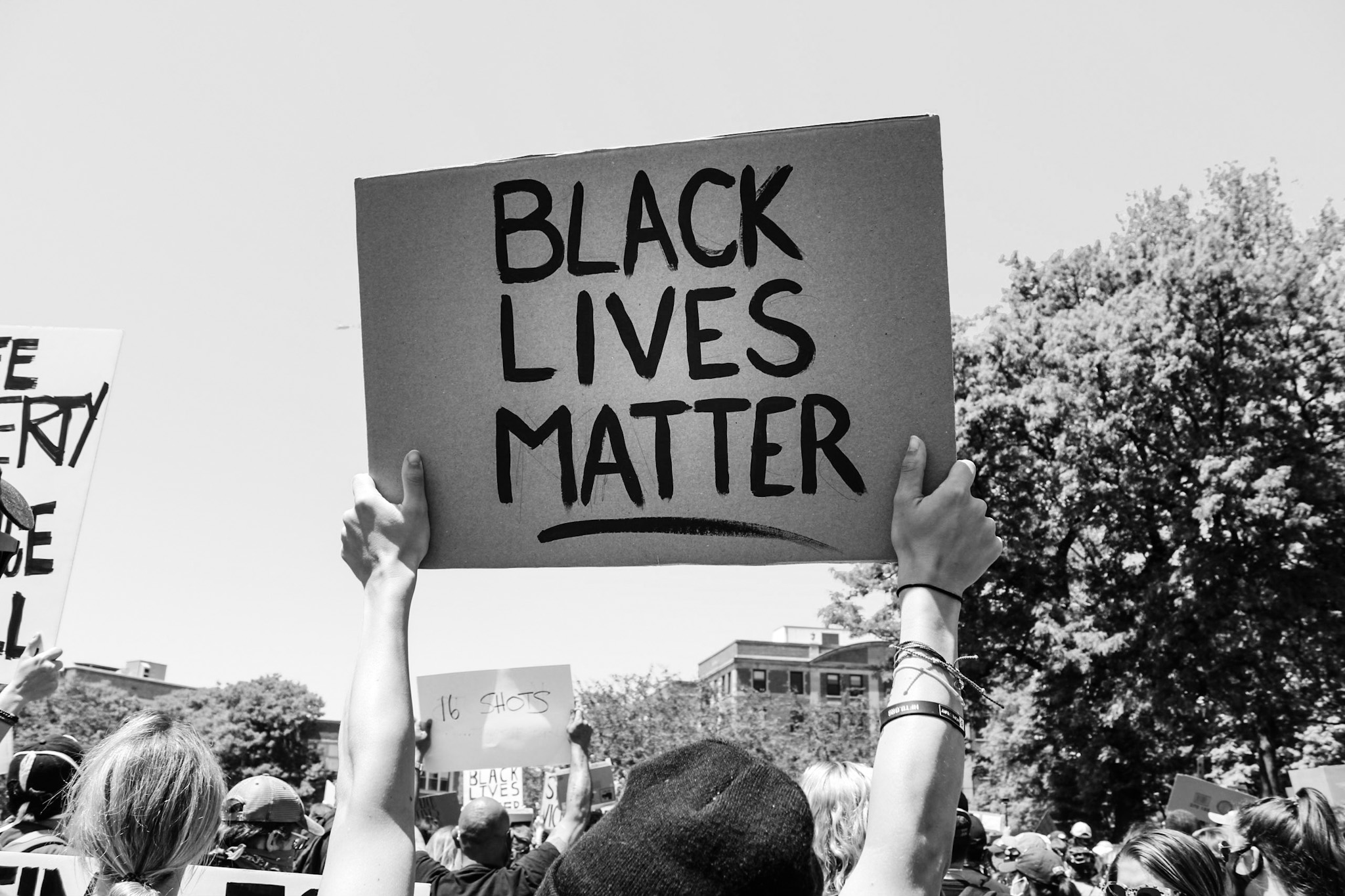
Last week, my family and I attended an interfaith rally in Los Angeles in defense of Black life. We performed a group ritual in which we made noise for nine minutes to mark the last moments of George Floyd’s life. My wife, my oldest daughter, and I played African drums to mark those nine minutes with the rhythm of a beating heart. Da-dum, da-dum, da-dum, over and over again.
While we drummed, I realized how difficult it is to keep up any physical activity for nine minutes straight. Most of us can’t even sit completely still on our butts for nine minutes; if you’ve ever meditated, you understand why they refer to sitting as practice.
As I struggled to maintain my posture and keep up the rhythm, I thought about the level of commitment it takes to hold someone down for nine minutes straight. The realization horrified me. The cop who has been charged with murdering George Floyd had to have been deeply committed to taking his life. The police officer had so many chances to let up the pressure, to let George live. Yet the officer made the choice not to.
To spend nine minutes taking the life-breath from another person: That is what white supremacy does to white people. That is what white supremacy does to the rest of us too. White supremacy robs each of us of our humanity. It causes white people to view Black people as less than human. Every one of those cops watching George die was convinced that the man pinned to the ground was less than human, was in some way disposable.
Otherwise, how could they hold him down for nine whole minutes? How could they bring themselves to do it?
You can’t have climate change without sacrifice zones, and you can’t have sacrifice zones without disposable people, and you can't have disposable people without racism.
During the street protests and marches of the past two weeks, many people carried signs that read “Racism Is Killing Us.” It’s no exaggeration to say that racism and white supremacy harm all of us, because in addition to robbing us of our humanity, racism is also killing the planet we all share.
An idea—a long-overdue realization—is growing in the environmental movement. It goes something like this: “We’ll never stop climate change without ending white supremacy.” This argument has entered the outdoor recreation and conservation space thanks to the leadership of Black, Indigenous, and other people of color in the climate justice movement. The idea has taken on new force as folks in the mainstream environmental movement do our best to show up for George Floyd, Breonna Taylor, Tony McDade, and all the Black people still living and subject to police violence.
I know that a lot of people are struggling with the thought that addressing the environmental crises must involve dismantling white supremacy. At Sierra Club meetings, some people hear me say something like that and think, “Damn, fighting climate change wasn’t hard enough already? Now we have to end racism and white supremacy too? Seriously, man?”
I get that feeling of being overwhelmed. It’s a lot to carry. It’s a lot to hold. We all have enough to do without feeling like we’re taking on even more.
But I want to share another lens from which we can view this moment. I really believe in my heart of hearts—after a lifetime of thinking and talking about these issues—that we will never survive the climate crisis without ending white supremacy.
Here’s why: You can’t have climate change without sacrifice zones, and you can’t have sacrifice zones without disposable people, and you can't have disposable people without racism.
We’re in this global environmental mess because we have declared parts of our planet to be disposable. The watersheds where we frack the earth to extract gas are considered disposable. The neighborhoods near where I live in Los Angeles, surrounded by urban oilfields, are considered disposable. The very atmosphere is considered disposable. When we pollute the hell out of a place, that’s a way of saying that the place—and the people and all the other life that calls that place home—are of no value.
In order to treat places and resources as disposable, the people who live there have to get treated like rubbish too. Sacrifice zones imply sacrificed people. Just think of Cancer Alley in Louisiana. Most of the towns there are majority Black, and nowadays they call it
Death Alley, because so many Black folks have died from the poison that drives our extractive economy. Or think of the situation in the Navajo Nation, where uranium mines poisoned the wells and the groundwater and
coal plants for decades poisoned the air. Or consider the South Side of Chicago, where I used to live, which for years was a dumping ground of petroleum coke (a fossil fuel byproduct) and
where residents are still struggling against pollution-related diseases. I’ve lived in a lot of places, and just about every place I’ve ever lived has been targeted by big polluters as a dumping ground.
Devaluing Black and Indigenous people’s lives to build wealth for white communities isn’t new. White settlers began that project in the 15th century, when they arrived in North America. Most Native peoples of North America lived in regenerative relationships with the land; they were careful to take no more than the land could sustain. The settlers had another ethic: They sought to dominate and control. They cleared the old-growth forests and plowed the prairies to make room for their wheat and their beef. They nearly drove the bison to extinction in a calculated scorched-earth tactic that was part of a larger ethnic-cleansing agenda. As the Potawatomi author and scientist Robin Wall Kimmerer put it in
a recent essay, “the Indigenous idea of land as a commonly held gift [was replaced] with the notion of private property, while the battle between land as sacred home and land as capital stained the ground red.”
How could the white settlers bring themselves to do it?
They did it by telling a certain story about Native peoples, a story that said Native peoples were less “civilized” than white settlers and therefore deserved to be terrorized and pushed from their lands. This Doctrine of Discovery was a religious belief for many European settlers. The doctrine said that any land “discovered” by Christians was theirs because of the inherent inferiority of non-Christian peoples. Eventually, this pernicious idea made its way into US law. In 1823, the US Supreme Court, in the case of Johnson v. M’Intosh, ruled that “the principle of discovery gave European nations an absolute right to New World lands.”
It’s no secret that our country was built on a foundation of enslavement of Black people, the theft of Native land, and near genocide of Indigenous people. US institutions, from our government to Ivy League colleges, were built on a foundation of stolen labor and stolen bodies. The compound interest on the profits from that enslavement became the basis of intergenerational wealth for white communities—the intergenerational wealth that perpetuates race-based economic inequality to this day.
But the past isn’t past. Structural racism continues 150 years after the abolition of slavery, only in new forms. As Michelle Alexander wrote in her best-selling book, The New Jim Crow, white supremacy has evolved over generations. After slavery came the debt-servitude of sharecropping. After the Jim Crow era was brought down by the civil rights movement, the prison industrial complex and the war on drugs (read: the war on Black people) rose in its place.
When a kid in East Oakland gets asthma from car pollution because her neighborhood is surrounded by freeways, that is white supremacy.
How does this all connect to today’s environmental crises? It’s all part of the same story of dehumanization. The pollution-spewing global mega-corporations that created Cancer Alley are just the latest evolution of the extractive white-settler mindset that cleared the forests and plowed the prairies. And just as the settlers had to believe and tell stories to dehumanize the people they killed, plundered, and terrorized, today’s systems of extraction can only work by dehumanizing people. Back then we had the Doctrine of Discovery, and today it’s the doctrine of neoliberalism that say it’s OK to value some lives more than others, that it’s OK for some people to have clean air while others struggle to breathe.
The crimes may be hiding in plain sight, but many white people are socialized to ignore how these systems of violence and inequality show up in our society. When it comes to racism, many white people are like fish swimming in water: White supremacy is so pervasive that it’s hard to even know that it’s there.
The richest people need for white supremacy to remain invisible so they can continue to plunder our planet. They need those sacrifice zones, and the racism that justifies them, or they’ll have nowhere to put their trash and pollution. In this way, white supremacy serves to divide white working people from Black working people. Today’s one-percenters are able to sacrifice whole communities using more or less the same methods the settlers used: By dividing people into racial categories and directing the worst of their abuse at the people at the bottom of a manufactured racial hierarchy. There’s a term for this: It’s called punching down.
This punching down usually comes in the form of blame. Media and popular culture often broadcast a twisted version of Black life and make it seem like communities of color have caused their own problems. Many people (at least half of Republicans, according to one poll) believe that poor people are poor because they are “lazy.” From there, it’s not much of a jump to believe that “some people” deserve to live next to a coal plant, that they deserve to die of cancer, that their children deserve to live with asthma.
Working-class whites are told a story that such a thing could never happen to them. Since the founding of this country, elites have conspired to divide poor and working people by race. Just think about Bacon’s Rebellion, when a wealthy white land-taker led a multiracial group of indentured servants and enslaved people on a mission of violence against local tribes. Afterward, frightened by the cross-racial uprising that had destroyed the state capitol, Virginia leaders began to offer more rights and privileges to white indentured servants to keep them from allying with enslaved African people and rising up against their rulers. They offered slightly better conditions to the white people they exploited, to keep them from seeing what they had in common with enslaved Africans and Indigenous peoples.
That same racist bargain—“You might be poor, but at least you’re not Black”—is alive and well in America today.
Now polluters tell low-income white families, “Only someone who doesn’t deserve anything better for themselves and their family would choose to live in such a polluted place as Cancer Alley.” If they just pull themselves up by their bootstraps, the story goes, white people can work themselves out of the poverty and environmental injustice they experience alongside Black people. Because, after all, at least they’re not Black.
In the Trump era, messages that blame Black folks for our own persecution come even from the White House. The Trump administration tries to explain away the fact that Black communities are dying at elevated rates from COVID-19 by pointing to preexisting health conditions, yet ignores that those health conditions are the result of generations of racism. The administration ignores the fact that the facilities that cause asthma are located in Black neighborhoods. It ignores the fact that living in a society that treats Black people as less than human causes stress on the heart, literally and metaphorically. According to the Harvard School of Public Health, “Being a person of color in America is bad for your health.” Put another way, Black folks’ only preexisting condition is being Black.
I’m still left wondering, how can they bring themselves to do it?
I think the answer has to do with the stories a lot of white people tell themselves. Stories that often boil down to a notion that Black people are always guilty and the cops (or the corporation) are always right. Stories that take the form of “he shouldn’t have resisted arrest.”
If all of this seems too neat a narrative, I’d ask if you remember Hurricane Katrina. In the aftermath of the storm, Black people who were just out looking for essential supplies were described by the news media as “looting” a grocery store. White people who were doing the same thing were described as “finding” bread and water. I’d ask if you remember Eric Garner and Dylan Roof. Eric Garner was choked to death by police for selling “loosies,” or single cigarettes. Dylan Roof murdered nine Black people during a Bible study group at their church; after being arrested, the police bought him a meal at a Burger King on the way to the police station.
Are you with me?
By dividing us up into racial categories and economic classes, the one-percenters keep us from seeing that 99 percent of us share the same problems. By focusing their extraction and pollution on Black communities and working-class families, big polluters have bought the silence and collusion of white Americans.
But let’s be real: White privilege offers no escape from climate chaos. Nobody reading this is going to get a spot on the SpaceX shuttle to Mars (if you think so, that’s white supremacy messing with your head). Earth is the only planet we get. And, thanks to polluters who profit from exploiting Black and brown communities, we’re in the process of making it uninhabitable.
Just as the settlers had to believe and tell stories to dehumanize the people they killed, plundered, and terrorized, today’s systems of extraction can only work by dehumanizing people.
When Amy Cooper, a white woman, has an encounter with a Black man birdwatching in Central Park
and calls the police—that is white supremacy. She weaponized the police and used them to racially terrorize someone. She knew what she was doing. She knew her threat had power because her target, Christian Cooper, understood the
historical relationship between the police and Black people.
When a petroleum pipeline corporation calls in the police
to bash Indigenous water protectors at Standing Rock, that too is white supremacy. It’s like the Amy Cooper–Christian Cooper incident but on a systemic scale in which a fossil fuel company weaponizes the police to racially terrorize Indigenous peoples.
When a kid in East Oakland gets asthma from car pollution because her neighborhood is surrounded by freeways, that is white supremacy.
When the Dakota Access Pipeline is built through Native land because the neighboring white communities fought to keep it out of theirs, that is white supremacy.
When the United States pours carbon pollution into the air, knowing that people in countries that have contributed much less to the climate crisis
will face the worst of the consequences, that is white supremacy.
When you come to see and understand these intersections between white supremacy and environmental destruction, you’ll find yourself at a crossroads. That crossroads will force you to decide which side you’re on.
You can choose—we as a society can choose—to live a different way. Indeed, we must. If our society valued all people’s lives equally, there wouldn’t be any sacrifice zones to put the pollution in. If every place was sacred, there wouldn’t be a Cancer Alley. We would find other ways to advance science and create shared wealth without poisoning anyone. We would find a way to share equally both the benefits and the burdens of prosperity.
If we valued everyone’s lives equally, if we placed the public health and well-being of the many above the profits of a few, there wouldn’t be a climate crisis. There would be nowhere to put a coal plant, because no one would accept the risks of living near such a monster if they had the power to choose.
Critics of the Black demand for justice and equality like to respond by saying “all lives matter.” It’s true; they do. In fact, that’s the very point of the chants and banners and signs in the streets. After centuries of oppression, the insistence on Black dignity is a cry for universal human rights. If Black lives mattered, then all lives would matter.
I know that what I’ve laid out here is a lot of dots to connect. I can imagine you thinking, “OK, so how do we end white supremacy then?”
I wish I had all the answers, but I don’t. The answer is for all of us to figure out together.
All I know is that if climate change and environmental injustice are the result of a society that values some lives and not others, then none of us are safe from pollution until all of us are safe from pollution. Dirty air doesn’t stop at the county line, and carbon pollution doesn’t respect national borders. As long as we keep letting the polluters sacrifice Black and brown communities, we can’t protect our shared global climate.
I also know that as long as police can take Black lives, then none of us are truly safe. I keep coming back to the murder of George Floyd, the nine minutes a cop took to bring the drumbeat of George’s heart to a standstill. I keep asking again and again, How could they bring themselves to do it?
And now I ask you, What will you bring yourself to do?
###