The Crazy Wisdom Community Journal • May - August 2013 • Page 39
If a link in a post doesn't open correctly hold down the CTRL (or Control) key and then click on the link. Then choose "Open in a new window (or tab)".
Wednesday, June 26, 2013
Tuesday, June 25, 2013
Canadian firm plans fracking campaign that could require 4 billion gallons of Michigan water
By Jeff Alexander/Bridge Magazine contributor
KALKASKA — A Canadian firm has laid out plans to drill 500 new natural gas wells in Northern Michigan, using a technique that could consume more than 4 billion gallons of groundwater — or about as much water as Traverse City uses in two years.
The firm, Encana Corp., will rely on hydraulic fracturing or “fracking,” a technique cloaked in controversy that requires large amounts of water, mixed with chemicals and other elements, to break down rock formations and release natural gas. Encana, for example, used 8.5 million gallons of groundwater earlier this month to frack a single gas well, the Westerman in Kalkaska County, east of Traverse City.
Because most of the water used in fracking becomes contaminated and is left in geologic formations deep underground, a recent surge in drilling by Encana and other companies has raised concerns that fracking could drain water from some of the state’s best rivers.
Encana recently drilled several new wells into the Collingwood shale formation, which lies about two miles underground. That’s the first step in a plan to drill 500 more deep shale wells in the region using fracking, according to company records.
The company’s plan to drill several new gas wells near Kalkaska will entail pumping about 300 million gallons of water out of the ground, injecting that water into several gas well bores and then leaving nearly all of the contaminated water in the ground when the fracking is completed, according to state records.
The result: A net loss of up to 300 million gallons of groundwater to the North Branch of the Manistee River, a blue-ribbon trout stream fed almost entirely by groundwater. One of Encana’s drilling sites is a half-mile from the Manistee River’s North Branch, according to company records.
“If the citizens of Michigan knew corporations were destroying hundreds of millions of gallons of Michigan water – water that is supposedly protected by government for use by all of us – they would be opposing this new kind of completion (fracking) technique,” said Paul Brady, a fracking watchdog who lives near Kalkaska. “These deep shale, unconventional wells are using massive amounts of water without adequate testing and solid data on aquifer capacity.”
Encana spokesman Doug Hock, however, is optimistic: “Can we access the (deep shale gas) and still protect the environment? Absolutely.”
State’s monitoring questioned, defended
Michigan’s Water Withdrawal Assessment Tool, a computer-based program launched in 2006, was supposed to prevent water withdrawals that could harm streams and rivers. The tool is Michigan’s first line of defense against excessive water withdrawals, but it was developed before drillers began using large quantities of water when fracking deep shale gas wells here.
But scientists, lawyers and Michigan courts have said the tool and other state estimates of stream flows are deeply flawed. If true, such a problem could result in the state inadvertently approving large water withdrawals that hurt rivers and streams.
Researchers at Michigan State University recently found several sites where the state’s water tool over-estimated the volume of water in small headwater streams that feed the Manistee River.
“In some watersheds, we are seeing that the assumed flows (calculated by the state’s water tool) are much higher than we measured. In one case the tool was off by a factor of three,” said David Hyndman, a hydrogeologist, professor and chairman of MSU’s Department of Geological Sciences.
Those findings were significant for three reasons, Hyndman said: Many of the Collingwood shale gas wells are being drilled in the ecologically fragile headwater areas of rivers; headwater streams are critically important to the health of entire river systems; and the state does little monitoring in headwater streams, where rivers originate.
Government and industry officials defended the state’s water assessment tool. State officials who developed the tool “did error analysis to make sure it was working and everywhere they tested, it worked,” said Jill VanDyke, a senior geologist with the Michigan Department of Environmental Quality.
The Water Withdrawal Assessment Tool estimates flows in Michigan’s 7,000 streams and river segments using data from river gauges and other information, including geology, soil characteristics, drainage area and precipitation. But only 2 percent of all river and stream segments in Michigan, 147 sites, have gauges that measure actual stream flows. That lack of in-stream data forced the DEQ to base much of the water assessment tool on general environmental conditions and mathematical models.
Dave Hamilton, a former DEQ official who helped develop the water assessment tool, said it takes a “very conservative” approach to ensure that large water withdrawals don’t cause adverse impacts.
“Ninety percent of the time there is more water in a stream than what the tool is saying,” said Hamilton, who is now a senior policy adviser for The Nature Conservancy’s Michigan chapter.
Well uses 3 million gallons from village supplies
State law requires using the tool to screen water withdrawals that exceed 100,000 gallons daily. If the tool raises a red flag, state officials conduct a site visit. Those site visits usually lead to permit approvals, according to DEQ officials.
Since 2008, the DEQ has issued 52 permits for large, fracking-related water withdrawals. Another 17 permits are pending, according to state data.
Fracking critics said recent problems at the Westerman gas well in Kalkaska County — where water wells didn’t produce as predicted and drillers had to truck in 3 million of gallons of water from Kalkaska and Mancelona to complete the fracking process — highlighted flaws in the water assessment tool.
Encana’s Hock and DEQ officials blamed the problem on “geologic conditions” unrelated to the water assessment tool.
“Everyone wanted to jump to the conclusion that the (water assessment) tool didn’t work and there wasn’t adequate water,” Hock said. “The tool worked well … it was a matter of really tougher rock than we anticipated.”
Industry watchdog Brady said the DEQ is trying to gloss over problems with the water assessment tool.
“Obviously the tool declared that the area had ample water and as we unfortunately found out the tool was inaccurate,” said Brady, who has written extensively about fracking on therespectmyplanet.org website.
Concerns about Michigan’s ability to accurately predict stream flows aren’t new. In 2005, the DEQ planned to issue a permit allowing an oil company to discharge 1.15 million gallons of slightly contaminated groundwater daily into Kolke Creek, the headwaters of the Au Sable River. The DEQ claimed that the index (or average) flow in Kolke Creek was about 6,000 gallons per minute, enough to dilute the oil company’s contaminated water without harming the creek.
As part of a lawsuit challenging the DEQ permit, independent scientists proved that the state’s estimate of Kolke Creek’s index flow was up to 100 times greater than the actual flow.
A state circuit court concluded that the state’s estimate of the flow in Kolke Creek was inaccurate and blocked the proposed discharge of polluted water into creek. The DEQ appealed but the state Court of Appeals upheld the lower court’s ruling.
The prospects for natural gas drilling – and the subsequent need for water supplies for fracking – have waxed and waned in Michigan in recent years.
First came a boom of investment in drilling rights on state property as petroleum firms lookedto extend natural gas exploration from Pennsylvania and Ohio into Michigan.
By late 2012, though, the pace of exploration in Michigan was still far below drilling rates seen in other Great Lakes states and low natural gas prices were seen as a potential brake on activity.
That may soon change.
Encana officials said the oil and gas industry wants to export natural gas extracted from shale formations in Michigan and other states to consumers in Asia. Demand for natural gas in China is strong and prices are double the cost of natural gas in the U.S., industry, watchdogs said.
China’s government-controlled energy company, Sinopec, has already invested $2.5 billion in a joint venture with Oklahoma-based Devon Energy. Devon has permits to drill several Collingwood shale wells in Northern Michigan, according to state records.
And late last week, Michigan Congressman Fred Upton, R-St. Joseph and chairman of the House’s energy panel, touted fracking as an aid in making the U.S. “energy independent” in natural gas:
“We’re the largest natural gas producer now in the world because of the advances that we’ve done on hydraulic fracking. … We are so rich in that resource.”
Monday, June 3, 2013
Sierra Club Michigan Chapter Earns Seat on NRCS Michigan Technical Committee
Award-Winning Factory Farm Researcher Lynn Henning to Represent the Chapter
Media Contact: Gail Philbin, 312-493-2384, gail.philbin@sierraclub.org
Lansing, Mich.— The Sierra Club Michigan Chapter has been appointed to the Michigan Technical Committee of the Natural Resources Conservation Service (NRCS), the body that advises State Conservationist Garry Lee about implementation of natural resources conservation provisions in the Farm Bill.
Sierra Club Water Sentinel Lynn Henning, who is internationally recognized for her work documenting factory farm pollution in Michigan, will represent the Michigan Chapter on the committee, which is comprised of representatives from government agencies, agricultural and environmental groups, agricultural producers and American Indian tribes. Henning received the 2010 International Goldman Environmental Prize for her work tracking environmental abuses at factory farms around her small family farm in southeast Michigan and around the state and helped alert authorities to violations and build cases against big polluters.
“I’ve been working on the factory farm pollution issue in Michigan for more than a dozen years,” said Henning, a Lenawee County native who farms 300 acres with her husband, Dean. “This is an exciting opportunity to bring what I’ve learned to the table and help the committee and Mr. Lee make better-informed decisions about how to spend taxpayer money when it comes to livestock operations.”
Michigan has 238 factory farms, also known as CAFOs (Concentrated Animal Feeding Operations), which confine thousands of animals in warehouses often for their entire lives or in crowded, open feedlots with no vegetation. These mega “farms” receive substantial taxpayer subsidies even when poor disposal practices of the millions of gallons of chemical- and contaminant-laden waste they generate lead to pollution of water, land and air, and violations of state and federal environmental laws.
Henning’s research into the relationship between factory farm pollution and subsidies in Michigan forms the basis for Restoring the Balance to Michigan’s Farming Landscape, a report released in February by the Less=More sustainable agriculture coalition. In particular, the report looks at subsidies in the Environmental Quality Incentives Program (EQIP), which is supposed to induce agricultural producers to implement conservation practices that address natural resource concerns and make improvements.
Restoring the Balance shows that the way subsidies are distributed currently by the Michigan State Conservationist, taxpayer money in the form of EQIP subsidies doesn’t always help solve an operation’s underlying environmental problems, but in fact, continues to go to support factory farms cited for environmental violations and discharges. The report found that 37 Michigan factory farms cited for environmental violations and unpermitted discharges over the 15 years ending in 2011 were awarded nearly $27 million in various Farm Bill subsidies between 1995 and 2011. Of these operations, 26 jointly racked up fines and penalties of more than $1.3 million for their share of these violations.
“Factory farms take a perfectly good natural material, animal manure, and concentrate it until it becomes an environmental hazard and then they receive taxpayer money for conservation practices that are supposed to ‘solve’ the problem they’ve created,” said Anne Woiwode, Sierra Club Michigan Chapter director. “And then when the problem isn’t solved, they get more money even as they continue to pollute.”
The NRCS State Conservationist is mandated to distribute 60 percent of the EQIP funds to livestock operations. Currently, most go to support factory farms in Michigan. Of the 104 EQIP subsidies available in 2013, 53 are practices identified by the NRCS as being applicable to farmers with organic certification, according to Henning. These include such activities as brush management, grassed waterways, fencing and filter strips.
Although about half of the practices are listed as organic, the reality is that the biggest EQIP subsidies go to support practices dealing with waste -- handling, storage, separators, transfer systems and biodigesters -- that are specific to large-scale operations with thousands of animals that generate millions of gallons of manure. For example, a factory farm can apply for and receive more than $43,000 for a solid/liquid waste separation facility, and anaerobic digesters fetch anywhere from roughly $300-$600 per animal unit, which translates to a substantial sum for an operation with thousands of animals.
“Our priorities are all wrong,” said Woiwode. “There’s a better way to raise livestock and a better way to spend taxpayers’ hard-earned dollars—we should stop giving subsidies to polluting factory farms and start using them to support more of the practices used by sustainable livestock farmers.”
Less=More is a sustainable agriculture coalition launched earlier this year to address the inequity of Farm Bill subsidy distribution in Michigan and how the system favors polluting factory farms over safe, sustainable livestock farms at the expense of the environment and public health. The coalition is comprised of national, state and local organizations engaged in various aspects of our food system, including: Beery Farms of Michigan, LLC, the Center for Food Safety, Crane Dance Farm, LLC, Environmentally Concerned Citizens of South Central Michigan, Food & Water Watch, Greater Grand Rapids Food Systems Council, Groundswell Farm, Humane Society of the United States, Michigan Farmers Union, Michigan Voices for Good Food Policy, Michigan Young Farmers Coalition, Sierra Club Michigan Chapter and Socially Responsible Agricultural Project.
Restoring the Balance to Michigan’s Farming Landscape and other information about Less=More is available at www.MoreforMichigan.org.
Media Contact: Gail Philbin, 312-493-2384, gail.philbin@sierraclub.org
Lansing, Mich.— The Sierra Club Michigan Chapter has been appointed to the Michigan Technical Committee of the Natural Resources Conservation Service (NRCS), the body that advises State Conservationist Garry Lee about implementation of natural resources conservation provisions in the Farm Bill.
Sierra Club Water Sentinel Lynn Henning, who is internationally recognized for her work documenting factory farm pollution in Michigan, will represent the Michigan Chapter on the committee, which is comprised of representatives from government agencies, agricultural and environmental groups, agricultural producers and American Indian tribes. Henning received the 2010 International Goldman Environmental Prize for her work tracking environmental abuses at factory farms around her small family farm in southeast Michigan and around the state and helped alert authorities to violations and build cases against big polluters.
“I’ve been working on the factory farm pollution issue in Michigan for more than a dozen years,” said Henning, a Lenawee County native who farms 300 acres with her husband, Dean. “This is an exciting opportunity to bring what I’ve learned to the table and help the committee and Mr. Lee make better-informed decisions about how to spend taxpayer money when it comes to livestock operations.”
Michigan has 238 factory farms, also known as CAFOs (Concentrated Animal Feeding Operations), which confine thousands of animals in warehouses often for their entire lives or in crowded, open feedlots with no vegetation. These mega “farms” receive substantial taxpayer subsidies even when poor disposal practices of the millions of gallons of chemical- and contaminant-laden waste they generate lead to pollution of water, land and air, and violations of state and federal environmental laws.
Henning’s research into the relationship between factory farm pollution and subsidies in Michigan forms the basis for Restoring the Balance to Michigan’s Farming Landscape, a report released in February by the Less=More sustainable agriculture coalition. In particular, the report looks at subsidies in the Environmental Quality Incentives Program (EQIP), which is supposed to induce agricultural producers to implement conservation practices that address natural resource concerns and make improvements.
Restoring the Balance shows that the way subsidies are distributed currently by the Michigan State Conservationist, taxpayer money in the form of EQIP subsidies doesn’t always help solve an operation’s underlying environmental problems, but in fact, continues to go to support factory farms cited for environmental violations and discharges. The report found that 37 Michigan factory farms cited for environmental violations and unpermitted discharges over the 15 years ending in 2011 were awarded nearly $27 million in various Farm Bill subsidies between 1995 and 2011. Of these operations, 26 jointly racked up fines and penalties of more than $1.3 million for their share of these violations.
“Factory farms take a perfectly good natural material, animal manure, and concentrate it until it becomes an environmental hazard and then they receive taxpayer money for conservation practices that are supposed to ‘solve’ the problem they’ve created,” said Anne Woiwode, Sierra Club Michigan Chapter director. “And then when the problem isn’t solved, they get more money even as they continue to pollute.”
The NRCS State Conservationist is mandated to distribute 60 percent of the EQIP funds to livestock operations. Currently, most go to support factory farms in Michigan. Of the 104 EQIP subsidies available in 2013, 53 are practices identified by the NRCS as being applicable to farmers with organic certification, according to Henning. These include such activities as brush management, grassed waterways, fencing and filter strips.
Although about half of the practices are listed as organic, the reality is that the biggest EQIP subsidies go to support practices dealing with waste -- handling, storage, separators, transfer systems and biodigesters -- that are specific to large-scale operations with thousands of animals that generate millions of gallons of manure. For example, a factory farm can apply for and receive more than $43,000 for a solid/liquid waste separation facility, and anaerobic digesters fetch anywhere from roughly $300-$600 per animal unit, which translates to a substantial sum for an operation with thousands of animals.
“Our priorities are all wrong,” said Woiwode. “There’s a better way to raise livestock and a better way to spend taxpayers’ hard-earned dollars—we should stop giving subsidies to polluting factory farms and start using them to support more of the practices used by sustainable livestock farmers.”
Less=More is a sustainable agriculture coalition launched earlier this year to address the inequity of Farm Bill subsidy distribution in Michigan and how the system favors polluting factory farms over safe, sustainable livestock farms at the expense of the environment and public health. The coalition is comprised of national, state and local organizations engaged in various aspects of our food system, including: Beery Farms of Michigan, LLC, the Center for Food Safety, Crane Dance Farm, LLC, Environmentally Concerned Citizens of South Central Michigan, Food & Water Watch, Greater Grand Rapids Food Systems Council, Groundswell Farm, Humane Society of the United States, Michigan Farmers Union, Michigan Voices for Good Food Policy, Michigan Young Farmers Coalition, Sierra Club Michigan Chapter and Socially Responsible Agricultural Project.
Restoring the Balance to Michigan’s Farming Landscape and other information about Less=More is available at www.MoreforMichigan.org.
Thursday, May 30, 2013
Fight Animal Factory Pollution!
BECOME A FACTORY FARM WATER MONITOR
Sign up for one of our free water monitoring webinars!
Tues., June 18,
7-8 pm
Thurs., June 20, 7-8pm
![]() |
| Lynn Henning takes a water sample from a stream near a CAFO in South Central Michigan. |
A key weapon in the fight against polluting animal factories is evidence volunteers gather in nearby waterways. Concerned citizens help collect vital data on pathogens and bacteria that end up in rivers and streams when manure waste runs off from farm fields, lagoon leaks or intentional dumping. They also check for lowered dissolved oxygen levels--caused by excess nutrients such as nitrogen and phosphorus from animal factories--that contribute to fish kills.
Sierra Club is offering two free webinars about animal factory water monitoring conducted by Goldman Environmental Prize Winner Lynn Henning. She’ll give an overview of the types of pollution caused by animal factories, how water monitoring is done and what Sierra Club does with the data.
Participants will also have the opportunity to sign up for advanced training to become a volunteer water monitor of an animal factory in their area.
Wednesday, May 29, 2013
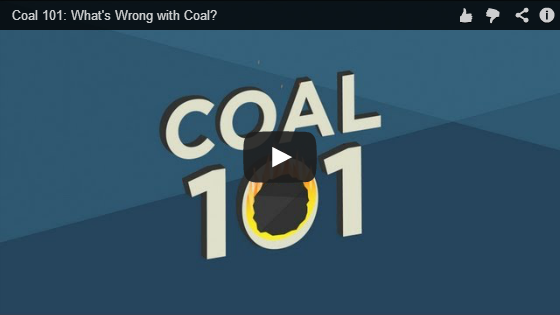
Everything That’s Wrong with Coal – and Right about Clean Energy – in 2 minutes (video)
FOR IMMEDIATE RELEASE
5/29/2013
Contact: Eitan Bencuya, eitan.bencuya@sierraclub.org, 202-495-3047
View as webpage
5/29/2013
Contact: Eitan Bencuya, eitan.bencuya@sierraclub.org, 202-495-3047
View as webpage
Everything That’s Wrong with Coal – and Right about Clean Energy – in 2 minutes
Sierra Club’s Beyond Coal Campaign Releases “Coal 101” Video, Detailing the Dangers of Coal
SAN FRANCISCO, CA -- Today the Sierra Club released a new video highlighting the dangers of mining, burning and disposing coal. This short video offers a helpful resource for explaining the problems with coal-powered dirty fuels, the benefits of clean energy, and the need to move the country beyond coal.
“It’s clear that coal is a dirty, dangerous and outdated fuel source that is making kids sick,” said Mary Anne Hitt, director of the Sierra Club’s Beyond Coal campaign. “From mining, to burning, to disposal, coal is wreaking havoc on our health and our planet. We hope this video helps viewers better understand the dangers of powering our country by burning coal, and why it is so important that we transition to clean, renewable sources of energy.”
Designed and produced in-house by the Sierra Club’s creative department, the animated video creates an engaging visual that details why it is so critical that we move off coal.
You can watch the full video at: http://sc.org/coal101 or watch the video in Spanish at: http://sc.org/ciclodelcarbon.
Friday, May 17, 2013
Shareholders Call on CMS Energy to Invest in Renewables at Annual Shareholder Meeting
Shareholders question CMS plans for continued reliance on dirty energy
May 17, 2013 - JACKSON – CMS Energy executives faced questions from shareholders Friday morning at their annual general meeting for shareholders about the company’s plans to continue investing in fossil fuel electric generation, like coal and natural gas, over renewable energy and energy efficiency.
“CMS Energy has an opportunity to be not just a true energy leader, but also more profitable down the road so it can continue creating Michigan jobs and providing Michigan energy to families and businesses,” said Debra Rowe, a CMS Energy shareholder from Farmington Hills. “It is time that CMS Energy expand their use of new, clean energy sources like solar and wind, not only for the health and safety of our communities but for a return on investment.”
CMS Energy has met it’s renewable energy goal and has lowered their renewable energy surcharge to customerrs further, as a result of lower than expected costs for renewable energy. The company also exceeded its energy efficiency goals and has been awarded performance incentive payments by the Michigan Public Service Commission, but continues to limit its investment to the bare minimum required by law.
“Shareholders are paying a heavy price as a consequence of CMS’ dependence on dirty energy. Michigan residents shouldn’t have to shoulder the burden of the utility’s risky business decisions,” said Frank Zaski, a CMS shareholder from Franklin. “Instead of investing in aging infrastructure to continue to burn dirty coal and build a new natural gas plant, CMS has the opportunity to earn returns on large capital investments in clean renewable energy, unleashing innovation and creating thousands of jobs for Michigan workers in new industries.”
CMS has been debating mothballing seven old coal units at the Cobb, Whiting and Karn Weadock plants in 2015, but recently requested an extension for 2016. The company has also been making costly updates at its other coal plants to continue to keep them running and plans to build a new 700 megawatt natural gas plant in Thetford, Michigan.
“It makes financial sense for CMS to continue to transition away from dirty coal and natural gas and start getting serious about clean energy and energy efficiency investments,” continued Rowe. “The company’s poor environmental performance and continuing investment in coal are putting shareholder value at risk.”
According to the U.S. Energy Information Administration (EIA), electric rates in Michigan are higher than in 38 other states and are among the highest in the country. Michigan rates were up eight percent last year, compared to rates across the country that were up one percent. By transitioning away from expensive, dirty coal to renewable sources like wind and solar power and by maximizing energy efficiency, CMS could save shareholders money.
# # #
Clean Energy Now is a collaboration of nearly 50 non-profit organizations in Michigan working to move our state toward a clean energy future.
Thursday, May 9, 2013
Less=More Coalition Offers Sustainable Livestock Farmers Easy Access to Subsidy Info
New Web Link Quickly Connects Farmers With Application and Subsidy List
Media Contact: Gail Philbin, gail.philbin@sierraclub.org, 312-493-2384
Lansing, Mich.— As part of its effort to help level the playing field for sustainable livestock farmers in Michigan, the Less=More Coalition has made available information about taxpayer-funded Farm Bill conservation subsidies in one place online at http://tinyurl.com/ EQIPsubsidies.
“Farmers are busy folks, and sustainable farmers often lack the kind of outreach and support for farm program applications that large-scale industrial farm operators receive,” said Sandy Nordmark, vice president of the Michigan Farmers Union, which is a member of Less=More. “We aim to make it as easy as possible for them to access funding possibilities for their conservation practices by putting all the information they need in one cyber-location.”
Less=More is a sustainable agriculture coalition launched earlier this year to address the inequity of Farm Bill subsidy distribution in Michigan and how the system favors polluting factory farms over safe, sustainable livestock farms at the expense of the environment and public health
The Less=More web link connects farmers with basic information about 2013 Farm Bill subsidies in the Environmental Quality Incentives Program (EQIP) in Michigan. It includes a listing of the more than 100 conservation practices funded by EQIP and the amount of money available for each practice as well as the most current EQIP application.
“This information is available on the USDA’s Natural Resources Conservation Service Michigan website, but it can be tricky to find if you don’t know where to look,” said Lynn Henning, a Water Sentinel for the Sierra Club Michigan Chapter, another Less=More coalition member. “We make it as simple as possible. A farmer can sit down and get an idea of what’s out there for him or her with a click or two of the mouse.”
The Natural Resources Conservation Service (NRCS), the agency that distributes taxpayer-funded subsidies through a State Conservationist in Michigan, is mandated to distribute 60 percent of the EQIP funds to livestock operations. Currently, most go to support Concentrated Animal Feeding Operations (CAFOs), also known as factory farms, in Michigan.
Of the 104 EQIP subsidies available in 2013, 53 are practices identified by the NRCS as being applicable to farmers with organic certification, according to Henning. These include such activities as brush management, grassed waterways, fencing and filter strips.
Although about half of the practices are listed as organic, the reality is that the biggest EQIP subsidies go to support practices dealing with waste -- handling, storage, separators, transfer systems and biodigesters -- that are specific to large-scale operations with thousands of animals that generate millions of gallons of manure. For example, a factory farm can apply for and receive more than $43,000 for a solid/liquid waste separation facility, and anaerobic digesters fetch anywhere from roughly $300-$600 per animal unit, which translates to a substantial sum for an operation with thousands of animals.
“Essentially, factory farms take a perfectly good natural material – animal manure — and concentrate it until it becomes an environmental issue and then they receive federal money to address the problem they’ve created,” said Anne Woiwode, Sierra Club Michigan Chapter director. “Meanwhile, sustainable farmers who work with nature and have appropriate numbers of animals for the amount of land available have little need for funds to address such problems, but they—and consumers--would benefit greatly from receiving more support for their sustainable practices.”
In addition, this taxpayer money doesn’t always solve an operation’s underlying environmental problems, according to a recent report by Less=More, Restoring the Balance to Michigan’s Farming Landscape, which demonstrates that many polluting factory farms have continued to receive taxpayer money. The report found that 37 Michigan factory farms cited for environmental violations and unpermitted discharges over the 15 years ending in 2011 were awarded nearly $27 million in various Farm Bill subsidies between 1995 and 2011. Of these operations, 26 jointly racked up fines and penalties of more than $1.3 million for their share of these violations.
“Taxpayers are providing millions of dollars in government subsidies to industrial mega-farms in Michigan that generate pollution and cause health risks while undermining sustainable farms at the same time,” said Woiwode. “This happens at a time when more and more Michigan consumers are seeking safe, healthy, local sources of meat, dairy, poultry and eggs at farmers markets, stores, restaurants and community supported agriculture.”
Less=More is a coalition of organizations engaged in various aspects of our food system that seek to level the playing field for sustainable farmers by addressing the inequity of how taxpayer subsidies are distributed in Michigan. It includes: Beery Farms of Michigan, LLC, the Center for Food Safety, Crane Dance Farm, LLC, Environmentally Concerned Citizens of South Central Michigan, Food & Water Watch, Greater Grand Rapids Food Systems Council, Groundswell Farm, Humane Society of the United States, Michigan Farmers Union, Michigan Voices for Good Food Policy, Michigan Young Farmers Coalition, Sierra Club Michigan Chapter and Socially Responsible Agricultural Project.
Restoring the Balance to Michigan’s Farming Landscape and other information about Less=More is available at www.MoreforMichigan.org.
Media Contact: Gail Philbin, gail.philbin@sierraclub.org, 312-493-2384
Lansing, Mich.— As part of its effort to help level the playing field for sustainable livestock farmers in Michigan, the Less=More Coalition has made available information about taxpayer-funded Farm Bill conservation subsidies in one place online at http://tinyurl.com/
“Farmers are busy folks, and sustainable farmers often lack the kind of outreach and support for farm program applications that large-scale industrial farm operators receive,” said Sandy Nordmark, vice president of the Michigan Farmers Union, which is a member of Less=More. “We aim to make it as easy as possible for them to access funding possibilities for their conservation practices by putting all the information they need in one cyber-location.”
Less=More is a sustainable agriculture coalition launched earlier this year to address the inequity of Farm Bill subsidy distribution in Michigan and how the system favors polluting factory farms over safe, sustainable livestock farms at the expense of the environment and public health
The Less=More web link connects farmers with basic information about 2013 Farm Bill subsidies in the Environmental Quality Incentives Program (EQIP) in Michigan. It includes a listing of the more than 100 conservation practices funded by EQIP and the amount of money available for each practice as well as the most current EQIP application.
“This information is available on the USDA’s Natural Resources Conservation Service Michigan website, but it can be tricky to find if you don’t know where to look,” said Lynn Henning, a Water Sentinel for the Sierra Club Michigan Chapter, another Less=More coalition member. “We make it as simple as possible. A farmer can sit down and get an idea of what’s out there for him or her with a click or two of the mouse.”
The Natural Resources Conservation Service (NRCS), the agency that distributes taxpayer-funded subsidies through a State Conservationist in Michigan, is mandated to distribute 60 percent of the EQIP funds to livestock operations. Currently, most go to support Concentrated Animal Feeding Operations (CAFOs), also known as factory farms, in Michigan.
Of the 104 EQIP subsidies available in 2013, 53 are practices identified by the NRCS as being applicable to farmers with organic certification, according to Henning. These include such activities as brush management, grassed waterways, fencing and filter strips.
Although about half of the practices are listed as organic, the reality is that the biggest EQIP subsidies go to support practices dealing with waste -- handling, storage, separators, transfer systems and biodigesters -- that are specific to large-scale operations with thousands of animals that generate millions of gallons of manure. For example, a factory farm can apply for and receive more than $43,000 for a solid/liquid waste separation facility, and anaerobic digesters fetch anywhere from roughly $300-$600 per animal unit, which translates to a substantial sum for an operation with thousands of animals.
“Essentially, factory farms take a perfectly good natural material – animal manure — and concentrate it until it becomes an environmental issue and then they receive federal money to address the problem they’ve created,” said Anne Woiwode, Sierra Club Michigan Chapter director. “Meanwhile, sustainable farmers who work with nature and have appropriate numbers of animals for the amount of land available have little need for funds to address such problems, but they—and consumers--would benefit greatly from receiving more support for their sustainable practices.”
In addition, this taxpayer money doesn’t always solve an operation’s underlying environmental problems, according to a recent report by Less=More, Restoring the Balance to Michigan’s Farming Landscape, which demonstrates that many polluting factory farms have continued to receive taxpayer money. The report found that 37 Michigan factory farms cited for environmental violations and unpermitted discharges over the 15 years ending in 2011 were awarded nearly $27 million in various Farm Bill subsidies between 1995 and 2011. Of these operations, 26 jointly racked up fines and penalties of more than $1.3 million for their share of these violations.
“Taxpayers are providing millions of dollars in government subsidies to industrial mega-farms in Michigan that generate pollution and cause health risks while undermining sustainable farms at the same time,” said Woiwode. “This happens at a time when more and more Michigan consumers are seeking safe, healthy, local sources of meat, dairy, poultry and eggs at farmers markets, stores, restaurants and community supported agriculture.”
Less=More is a coalition of organizations engaged in various aspects of our food system that seek to level the playing field for sustainable farmers by addressing the inequity of how taxpayer subsidies are distributed in Michigan. It includes: Beery Farms of Michigan, LLC, the Center for Food Safety, Crane Dance Farm, LLC, Environmentally Concerned Citizens of South Central Michigan, Food & Water Watch, Greater Grand Rapids Food Systems Council, Groundswell Farm, Humane Society of the United States, Michigan Farmers Union, Michigan Voices for Good Food Policy, Michigan Young Farmers Coalition, Sierra Club Michigan Chapter and Socially Responsible Agricultural Project.
Restoring the Balance to Michigan’s Farming Landscape and other information about Less=More is available at www.MoreforMichigan.org.
Subscribe to:
Posts (Atom)